 English
 Español
 Français
 Русский
 Português
 Deutsch
 العربية
What is the heat treatment of grinding balls?
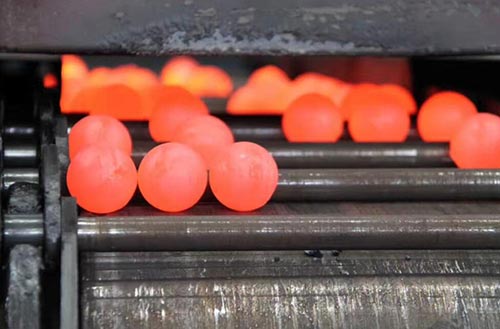
Heat treatment is a vital process for grinding balls that greatly improves their overall performance and extends their service life. As a professional manufacturer of grinding media, Shandong Jinchi Heavy Industry applies precise heat treatment techniques to optimize the quality of grinding balls, ensuring they meet the rigorous demands of industrial grinding applications. Here is a detailed overview of the grinding ball heat treatment process and its key benefits:
Core Processes of Grinding Ball Heat Treatment
1. Austenitizing
Purpose: To convert the internal microstructure of grinding balls into austenite—a face-centered cubic iron phase that enables effective subsequent hardening.
Process: Grinding balls are heated to a high temperature, generally ranging from 800°C to 1000°C, until their structure is fully transformed into austenite.
2. Quenching
Purpose: To rapidly cool the austenitized grinding balls, fixing the austenitic structure into a hardened phase for enhanced hardness.
Process: The heated grinding balls are cooled quickly, commonly in water or oil mediums. This rapid cooling process transforms austenite into martensite, a hard yet brittle crystalline phase.
3. Tempering
Purpose: To reduce the brittleness caused by martensite and improve the overall toughness and ductility of grinding balls.
Process: Quenched grinding balls are reheated to a relatively low temperature, typically 150°C to 200°C, held at this temperature for a set period, and then cooled slowly in a controlled way.
4. Normalizing (Optional)
Purpose: To refine the grain structure of grinding balls and enhance the uniformity of their mechanical properties.
Process: Grinding balls are heated to a temperature above the critical point and then cooled naturally in air to complete the process.
JINCHI
Welcome to send your message to us